

For years, Germany’s political mainstream relied on the so-called Brandmauer (or firewall) to keep extremists out of power by isolating them. That era is now over.
On Sunday, the far-right Alternative für Deutschland (or AfD) received 43.8% of the votes in Saxony-Anhalt, the best result of any party in the state since reunification in 1990. By contrast, the Christian Democratic Union (CDU) — Chancellor Friedrich Merz’s party and the state incumbent — tumbled by more than half to 17.2%. That’s an unprecedented loss of legitimacy and will further weaken Merz and his coalition.
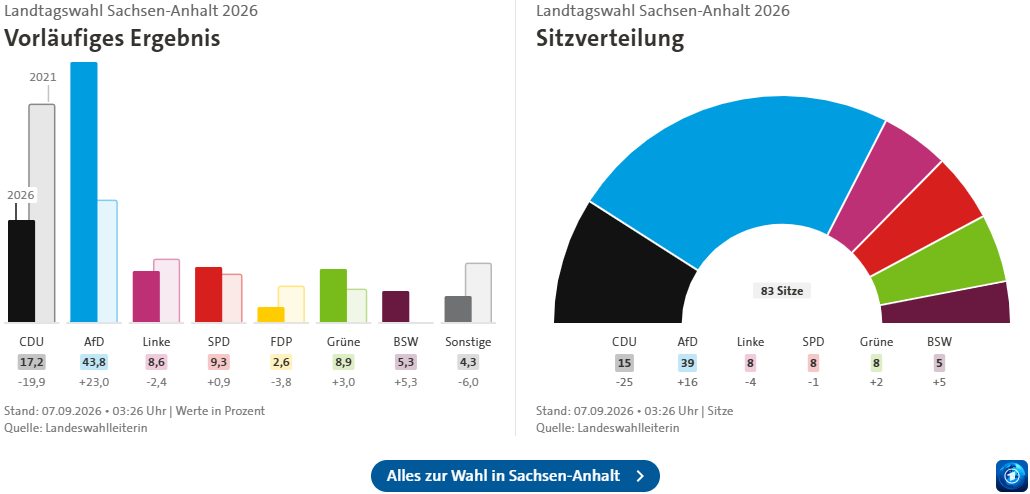
While the anti-immigration AfD — a party labeled right-wing extremist by Germany’s domestic intelligence service — doesn’t have the necessary seats in the state legislature to govern on its own, setting up a coalition without its participation risks looking like a power grab that ignores the will of the people.
That could end up validating the AfD’s rhetoric that the mainstream is just looking out for itself, bolstering the party even more. That would undermine the Brandmauer’s stated purpose of preventing a renewed drift into authoritarianism after the Nazis and the East German police state.
So while the firewall might live on in name, it can’t continue like it did before. And that’s a good thing, if it serves as a catalyst for honest political renewal.

One Basic Question
The Brandmauer may have originated as a well-meaning lesson from Germany’s violent past, but in recent years, it gave mainstream parties — above all the CDU and the co-ruling Social Democrats — a false sense of comfort. By treating the AfD as a common enemy, there was little need to develop new solutions.
I recall speaking last year at a panel discussion hosted by an SPD-affiliated organization, and my main message was stop making policy against the AfD and start making policy for the people. But business as usual persisted despite clear signs that the cordon sanitaire was crumbling and a new strategy was needed.
By seeing themselves as the embodiment of the democratic order rather than a participant, the self-delusion justified actions like in 2020, when the AfD leveraged the parliamentary process to elect an outsider as premier of the state of Thuringia. The maneuver created an uproar, forcing FDP lawmaker Thomas Kemmerich to resign the post within days.
Now because of the firewall, Thuringia is run by an unstable anti-AfD coalition led by the CDU. Since that election in 2024, support for the far-right party has strengthened, as the Brandmauer’s role in reinforcing its anti-establishment credibility.
In Saxony-Anhalt, the AfD could still gain power by securing tacit support from other parties (such as BSW, which like the AfD wants to halt aid to Ukraine and revive energy ties with Russia). It could also convince individual lawmakers to switch allegiances, the door has already been opened to CDU counterparts (the AfD would need at least three to cross over — not necessarily a massive hurdle in these turbulent times).
On a basic level, Germany’s mainstream has never quite answered a very fundamental question amid all its posturing for democracy: why?
Two Bad Choices
Taking democracy as a monolithic and self-evident good is widespread across the “West.” Representatives of the status quo bang the drum about the pending collapse of liberalism.
But people have come to understand that such scare tactics are really about protecting power and not sharing it. They know what those results look like and many want something else.
Right now, though, right-wing populism is the only alternative really on offer, alongside the moribund status quo. But it doesn’t have to be that way.

That’s what Ground Up aims to do: show that there is a constructive way forward. But a substantive devolution of economic and political power is inherently more complicated than tapping into nationalistic tropes, especially in Germany.
A state like Saxony-Anhalt would be a great place to start. It has no big listed companies, but many small firms. Supporting and facilitating entrepreneurs and encouraging them to invest and develop locally could meaningfully move the needle in one of Germany’s poorest regions. Citizens councils could also partner with local administrators to engage the public and develop programs tailored closer to the needs of the communities, which are among the oldest in Germany.
But without credible perspectives, the people in Saxony-Anhalt have become particularly receptive to blood-and-soil myths, and for good reason. After reunification gutted social life and economic status, droves of young people left for better opportunities elsewhere. As a result, the population declined by nearly a third, local services collapsed and unemployment shot up.
Grievances have quietly simmered for decades. But instead of political and economic freedoms nurturing “flourishing landscapes” (as envisioned by Helmut Kohl), locals were sidelined by forces they had little ability to influence.
Similar feelings of alienation will be familiar to many in today’s world, where the destabilizing potential of artificial intelligence, geopolitical turmoil and the climate crisis tear at the fabric of the old order.
What’s become increasingly clear is that new threads need to be spun to tie people together. That realization could be the silver lining. But there’s new guarantee that renewal comes from the mainstream or that new political actors emerge to fill the vacuum.
For Germany’s political establishment, there is little time to recover. The next test is already on Sept. 20, when Berlin and Mecklenburg-Vorpommern vote. If the CDU and SPD continue to struggle, it could spell the end of Merz’s coalition, which was supposed to be the “last bullet” of German democracy.