

A neighborhood in Brooklyn was still scarred by foreclosures linked to the global financial crisis when the Covid pandemic hit. With lockdowns reducing incomes and causing household debts to pile up, residents didn’t want to see a new wave of neighbors get forced out, so they decided to do something about it.
That effort has become the East New York Community Land Trust, which now controls a 21-unit apartment building and a 9,500-square-foot commercial site. It’s part of a growing movement in New York with similar initiatives operating more than 1,200 affordable housing units, triple the number from a decade ago.
Like its peers, the East New York trust owns the land and leases the buildings on it to tenant shareholders. That takes profiteering out of the equation and maintains control over physical resources so they serve the community.

The concept is known as land stewardship and the goal is to shift real estate away from private ownership. Advocates call it an investment with a 1,000-year time horizon, highlighting how people in the present have responsibility to hand over a better asset to generations in the future.
There are examples of how it works well. The Menominee forest in Wisconsin has been sustainably logged by the same tribe for over 160 years, with timber volume increasing over that period. The secret is prioritizing the land first, then community and finally profit — with well-managed stewardship, one leads to the other.
The modern version of the community land trust started in Georgia in 1969 by Black farmers seeking to stay on the land they tilled. It expanded eventually to places like Vermont, where the Champlain Housing Trust is one of the largest. Now, there are more than 300 across the U.S.
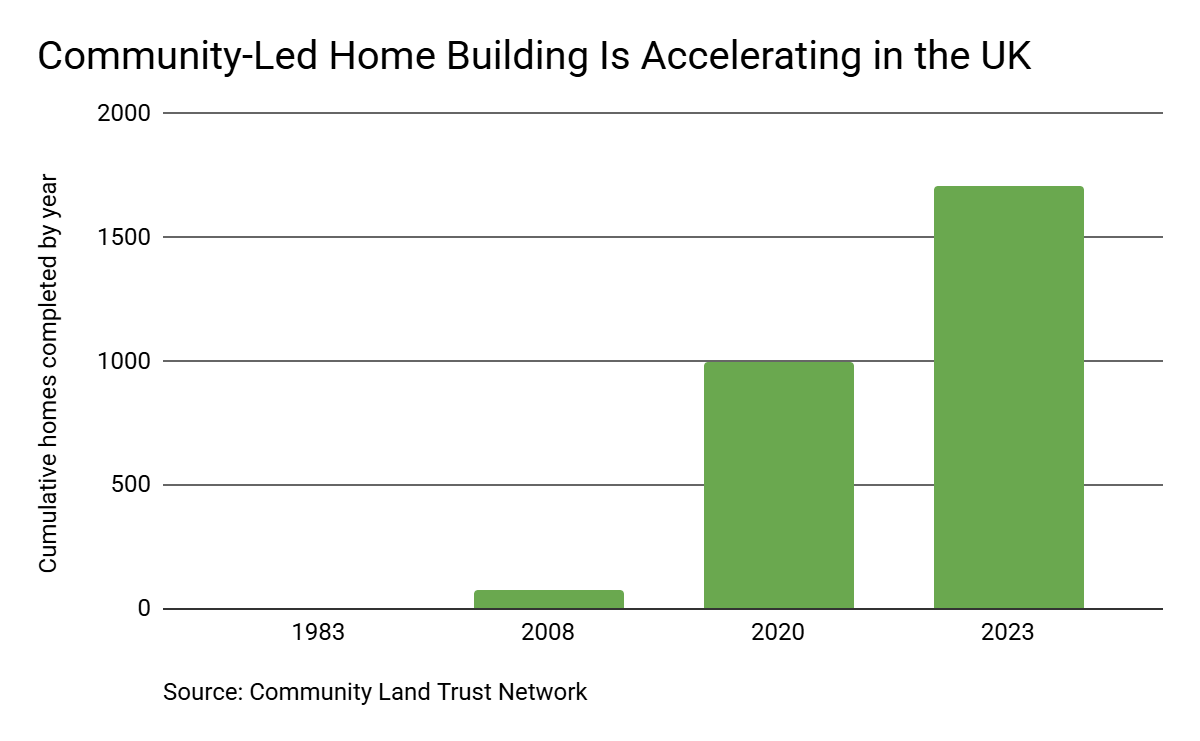
Housing shortages are a key motivator as the conventional real estate model breaks down across the West. In the UK, community land trusts have constructed over 1,700 homes as of 2023 — a sharp acceleration from roughly 1,000 homes three years earlier — and thousands more are in the pipeline. Britain’s Community Land Trust Network sees the potential for hundreds of thousands of homes as it rolls out a toolkit for communities to organize and get building.
Land is the fundamental building block of human civilization. No matter what AI does to the internet, we need physical real estate to create shelter, grow food and secure energy and raw materials. While land is obviously finite, it’s treated like any other commodity — a good to be bid on by the market, with its underlying value dependent on its usage.
But the dark sides of extractive ownership are becoming increasingly visible as the climate crisis intensifies. The marks are evident in places like the Niger Delta, where decades of oil drilling and thousands of spills contaminated soil and groundwater. In Appalachia in the U.S., France’s Pas-de-Calais, China’s Liaoning province and Germany’s Ruhr Valley, coal mining has devastated landscapes and broken communities after the wealth was taken out and investors moved on.
The rationale for owning a piece of the natural world is underpinned by the so-called tragedy of the commons, a concept that posits that shared resources lead to overuse if individuals can secure the benefits and avoid the costs.
The argument is that if you could go to a park, stick a tube in the ground and siphon off a couple barrels of oil, you’d probably take as many barrels home as possible until the park was dried up and reduced to a mess. So private ownership is needed to impose discipline.
False Dichotomy
So does land need an owner to prevent overuse, or does ownership itself enable the worst abuses?
Research by Elinor Ostrom, the only woman to win the Nobel Prize for economics, suggests the question is built on a false choice between private ownership and government control.
“The classic assumptions…hide the potentially productive efforts of individuals and groups to organize and solve social dilemmas,” she said in her Nobel Prize lecture in 2009. Unlike in thought experiments like the prisoners’ dilemma, where two accomplices are interrogated separately and end up confessing to their own detriment, real people can communicate with one another, she noted in her research.
Ostrom’s work showed that individuals and groups can act rationally and that there was never a simple dichotomy between private gain and common tragedy. The third way is shared control by those directly affected by the costs and the benefits. That leads to stewardship rather than exploitation.
By studying historical examples of what works and what doesn’t, Ostrom set up a rulebook to properly manage common resources:
Clear boundaries — everyone needs to know what the resource is and who’s a legitimate user.
Rules that fit local conditions — there’s no one-size-fits-all. Costs and benefits need to be proportional and bearable for the people using the resource.
Collective decision-making — the people affected by the rules get a real say in setting them, and are therefore more likely to abide.
Monitoring — accountable oversight, often by the users themselves.
Graduated sanctions — rule-breakers face escalating consequences, which Ostrom found built more durable compliance than harsh top-down punishment.
Accessible conflict resolution — cheap, fast, local ways to settle disputes.
Recognized rights to self-organize — a commons won’t endure long if the state overrides the community’s rights.
Nested governance — for larger, more complex commons, layered levels of organization are better than centralized authority.

East New York’s land trust is just five years old. Against a 1,000-year horizon, it’s barely begun. If the model holds, the founders will end up being just the first stewards in a long legacy.
That’s what devolution is about: institutions built to provide connection for now and into the future. It provides something that a world reduced to markets and transactions can’t: purpose. And it can only be built from the ground up.
Nice one - I’m now remembering how much I enjoyed readying Federici’s Politics of the Commons ages ago. I like the idea that some things shouldn't be subject to market logic or pure state control at all (and that democratic, participatory management of shared resources is both more just and often more effective).
Sehr gut - ähnliche Initiativen nebeneinander gestellt. Stadtwerte will den Fokus genau auf solche WERThaltigen Elemente staatlicher und gesellschaftlicher Organisation legen.
Gern stellen wir die kommunalen Wohnungs- und Liegenschaftsgesellschaften in Deutschland dem einmal gegenüber. Daraus dann Vor- und Nachteile abzuleiten, hilft im Denken weiter.
Wir müssen uns bald mal in Ruhe treffen, Chris! ⭐️