
Because some ideas can only really be approached obliquely, please allow a moment for abstraction:
Once upon a time, at the dawn of the age of liberalism, a monument was created. It was a symbol designed to represent the power and promise of what the free individual could be — strong, steadfast and independent.
The monument had flaws, to be sure. Its original design was rather hollow and not properly grounded, but that didn’t diminish its appeal. The message spoke to the people.
While the old system hemmed them in by rank and station, every single person could only see the world through their own eyes and manipulate it with their own hands. They were individuals and could be nothing else. If their ideas and perceptions were their own, their lives should be too.
In that yearning to be free, they saw themselves in that construct and were guided by its image.
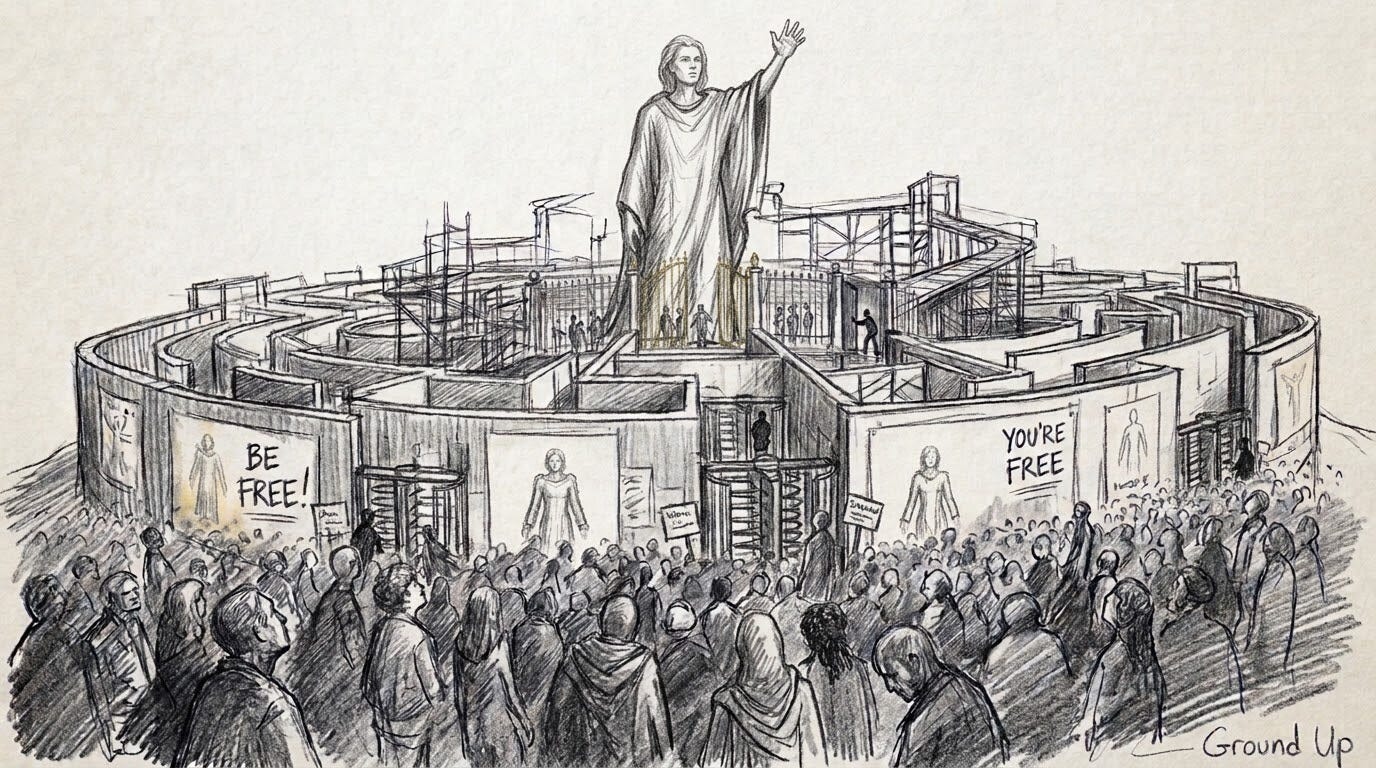
Then something happened. The monument was taken away, sequestered by those who found it easier to sell freedom than share it. That universal right became something to be bought through credentials, capital and connections.
To be clear, the monument was not destroyed. Far from it. The image became more present than ever. The free individual was portrayed in glossy brochures and moving testimonials.
But the reproductions corrupted the message. Instead of empowering the people, the representations of unfettered freedom and individuality teased them, asking why they weren’t strong, steadfast and independent.
“Your chains are gone. It’s up to you to make your happiness, and therefore it’s surely your fault if you fail,” the monument’s guardians whispered to the people, leaving them to feel nasty, brutish and solitary.
Access to the monument was indeed granted. An entire apparatus was constructed for that very purpose. Complex structures were installed to ensure only a privileged few could enter the gilded gates, where everything was allowed and everything was possible.
The well-known existence of a way in was part of the monument’s enduring appeal, but gaining access was tightly secured and a primary part of achieving that privilege was to close the gate behind you.
Hopefully, none of that is too abstract to see that I’m describing where we are in the twilight of the market-first version of the Enlightenment tradition.
Ideals of the free individual were powerful and helped topple absolute monarchies, but they have been turned inside out under neoliberalism, which sought more aggressively to roll back the public sphere. That process started in the 1970s and 1980s and has become clearly dominant since the end of the Cold War — and subsequently exported through globalization.
In its contemporary manifestation, the concept of the free individual is no longer empowering. Instead, freedom separates one person from another, atomizing society and hindering people from seeing and acting on their commonalities.
As a result, the idea helps perpetuate a system struggling to provide basic needs like affordable food and shelter, much less make good on grandiose pursuits such as peace, prosperity and happiness. Because if success is purely individual, so is failure, and collective provision starts to look like charity.
An idealized sense of ‘pure freedom’ does not emancipate the individual
The construct that liberal societies are built around was hollow from the start because people are born into specific conditions. Values and identity are always contextual. There is no “state of nature” from which we emerge.
So while we are all clearly individuals, I am not “free to do what I want any old time,” as Mick Jagger and Keith Richards wrote in the 1960s (and revived by The Soup Dragons in 1990 just after the Berlin Wall fell).
We are born into a web of conditions like sex, family status and socio-economic standing. We are influenced by nature, subject to political and economic systems, and affected by the people we encounter (just as we affect them).
Trying to wipe away those conditions with an idealized sense of pure freedom does not emancipate the individual. It casts them into the ether without a tether. Bearing the burden for society’s failings is getting harder as the liberal system falters.
Cost-of-living anxiety and work that for many is meaningless deepen the alienation, and AI now threatens even that source of connection. With labor devalued as a form of participation, the system’s defenders have emphasized consumerism as the expression of individuality, an even emptier construct (as I wrote about here).
Isolation and loneliness is like smoking up to 15 cigarettes a day
The social cost shows up in the data. About one in five U.S. adults reports feeling lonely much of the day, Gallup reported in 2024. The World Health Organization puts the global figure at roughly one in six. The U.S. Surgeon General issued an advisory citing that time spent in-person with friends fell to 10 hours a month in 2020 from 30 hours in 2003.
While the pandemic may have exaggerated the trend, the slide was already underway. An analysis by the Philadelphia Fed found the share of free time spent with people outside the household had fallen to 17.3% in 2019 from 21.9% in 2003. The steepest declines were among low-income, less-educated and non-white Americans.
Globally, the measured impact came later. A 159-country study found social isolation rising to 21.8% from 19.2% between 2009 and 2024, with the entire increase coming after 2019 and the first jump landing hardest on lower-income groups (the people farthest from my metaphorical monument).
The impacts are real. In 2023, the Surgeon General called loneliness and isolation an “epidemic,” warning of higher risks of cardiovascular disease, dementia and stroke, and an impact on life expectancy comparable to smoking up to 15 cigarettes a day. WHO’s Commission on Social Connection has linked loneliness to an estimated 871,000 deaths a year between 2014 and 2019, roughly 100 every hour.
‘Possessive individualism’ describes the assumption that a person is the sole proprietor of themselves and owes nothing to society in return
Many forces are at work here — from smartphones and aging societies to the pandemic and economic precarity. One idea doesn’t explain all of it, but a culture that tells people their lives are theirs alone leaves them nowhere to put their problems except on themselves.
This level of isolation may seem surprising in an era when people in liberal countries are ostensibly free to choose beliefs, partners and identities in ways that would have been unthinkable throughout most of human history.
But it’s not at all surprising when we consider that the concept of the individual was constructed in opposition to society. Philosopher C.B. Macpherson diagnosed this in 1962 with his theory of “possessive individualism,” which describes the assumption that a person is the sole proprietor of themselves and owes nothing to society in return.
So if individual freedom effectively means buying a ticket that few can afford, what do we do about it?
A key project involves reconceptualizing what it means to be free. Instead of rejecting the social sphere as hostile to a free individual, we need to acknowledge that real freedom can only run through society. Building that pathway is the essence of the Ground Up project.
Freedoms are hollow without the means for people to actively use them
None of this means trading away individual rights. Freedom of conscience, speech and choice were hard-won and were the reason the monument inspired people in the first place.
The argument here is that those freedoms are hollow without the means for people to actively use them to influence the decisions that shape their lives. A society that expects everyone to stand alone isn’t protecting freedom. It’s rationing it.
After all, humans are social animals. We need one another to achieve basic needs like food and shelter, and especially for grandiose pursuits like peace, prosperity and happiness.
It’s not a new idea. Aristotle described the human being as a zoon politikon — a political animal — meaning that a person outside a community was not freer, but diminished. More recently, philosopher Michael Sandel criticized the “unencumbered self” in the 1980s, arguing that we are always partly defined by roles, relationships and obligations we didn’t choose.
That means we need to take back the monument, fill it with real content and build pathways that open access rather than close it.
That kind of construct would lead to different institutions, ones that enable participation in politics and the economy and restore balance between the individual and the social sphere. Citizen forums, workers councils and cooperative land stewardship would give people a say, a stake and others to act with, which is what makes freedom meaningful.
In the metaphor version, it looks something like this:
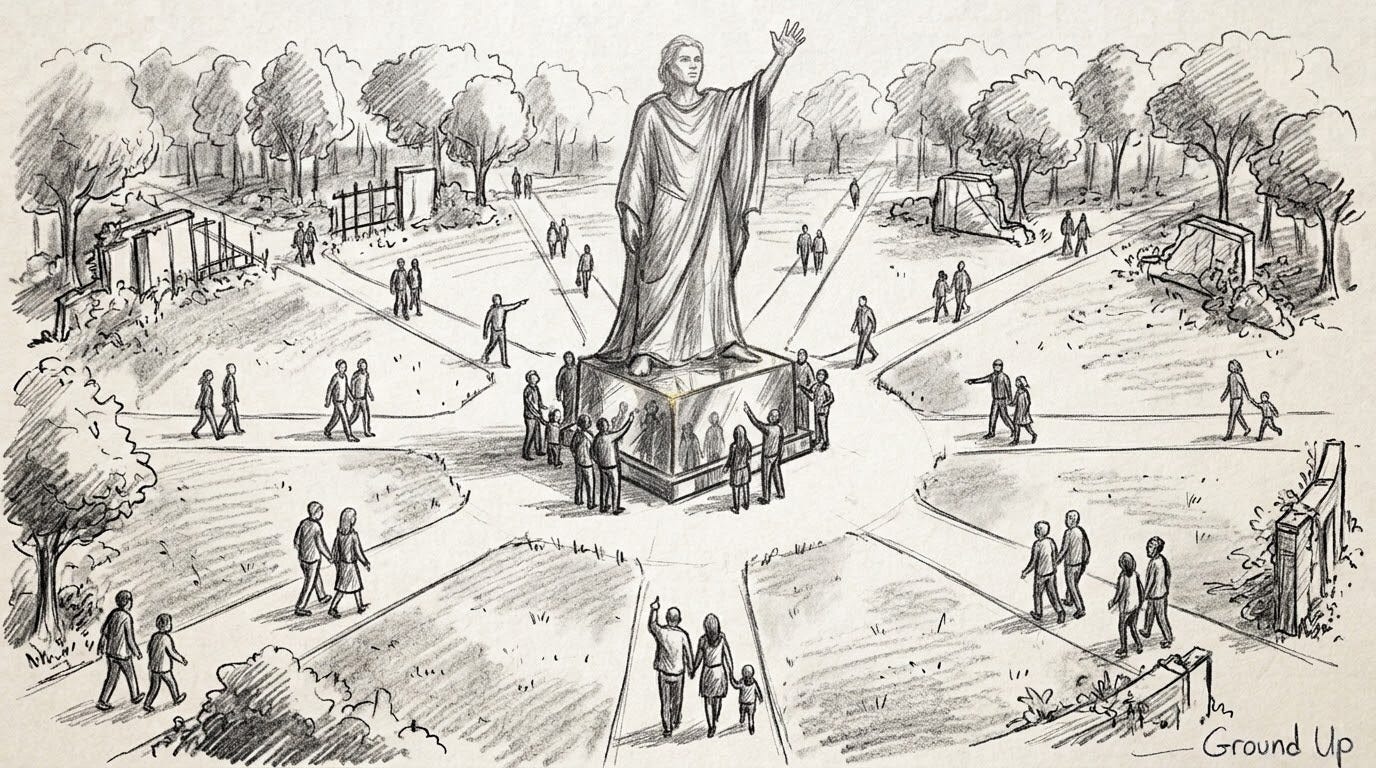
One day, the apparatus that restricted access to the monument of the free individual collapsed, no longer able to sustain the weight of the throngs pressing toward it.
To prevent new obstacles from being constructed, the people installed the monument in the middle of a public park, with the ruins of the former gates nearby as a warning.
Paths were established and clearly marked to show a myriad of ways to reach the goal. Firmly anchored and its shell reinforced from within, people from all sides could converge and take part.
As they approached, people could see that the monument was not a dull, static material. The construct and its foundation were mirrored, and the people could see themselves and one another reflected in it.