

In March 2008, I was assigned to cover finance in New York. On my first day, the investment bank Bear Stearns collapsed. It was the beginning of the global financial crisis, and I had a front-row seat to watch how the system was no longer serving the people.
In the U.S., the fallout meant some 6 million households were displaced, homes foreclosed and lives disrupted. On the other side of the ledger, almost no one went to jail — one mid-level banker, and no major Wall Street executives — for what was effectively systemic-level fraud.
While some countries cracked down harder, the basic disparity was largely the same and demonstrated just how the system was skewed against the majority.
Ultimately, banks were bailed out and bad ones swallowed up. The financial system recovered and big banking bonuses returned. For defenders of the neoliberal order, it was proof of its resilience. But fast forward to today and more evidence of a broken social contract is piling up. And there’s a consistent pattern: the elite is insulated while everyone else suffers.

A simple question
Now, we’re in a situation, where living costs are mounting, jobs are shaky, and home ownership is out of reach for many. Trade wars, real wars and climate catastrophes add more incalculable risks to people’s lives. The precarious conditions strain the bonds of belonging, and the social fabric frays.
That wasn’t the deal. Generating prosperity was what the liberal system was supposed to be good at. It was supposed to sweep you along with the rising tide and carry you, your family and your community to higher ground. Instead, more and more people are left to sink or swim.
For some, there are reasons to dismiss the decline as overblown. Unemployment has recovered from the global financial crisis and the Covid pandemic. And GDP keeps growing across most major economies.
The collapse narrative, critics argue, mistakes periodic friction as evidence that the entire system is failing. But that’s not really the point. The sky doesn’t have to be falling to realize that roof needs repair or that the flooring needs to be reinforced.
Cutting through the false equivalencies of its all good or its all bad is a simpler question: Is this the best we can do?
I don’t think so. I think we can build something better, without destroying the planet and people’s livelihoods in the process. That’s what Ground Up is about.
Systemic disconnect
It’s hard to honestly argue that the system is working — at least not for the majority.
Wealth inequality is widening and reaching levels in the U.S. that were last seen before the Great Depression. The ultra-rich are undermining democracy and tilting government policy in their favor around the world. AI threatens creating more upheaval, and the climate crisis threatens the well-being of the entire planet.
That’s triggering a crisis of legitimacy. The liberal order is built around the idea of individual freedom, but there is no liberty for people living from paycheck to paycheck or drowning in debt. What value is voting for a limited array of candidates if policies favor the haves?
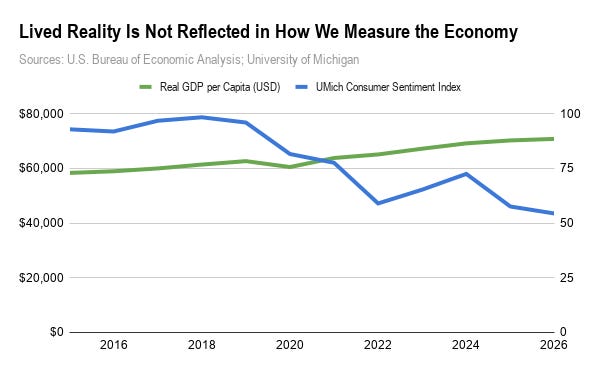
While that tension doesn’t show up in economic indicators, you can see it in waning trust. Gallup has tracked confidence across U.S. institutions since 1979 and in the latest reading, it was near a record low. Similarly, Pew’s federal trust number, which is even older, sits near the lowest point in the nearly seven decades.
The trends aren’t isolated to the U.S. Developed democracies — Japan, France, Germany, the UK, Spain, South Korea as well as the U.S. — ranked among the lowest on the 2026 Edelman Trust Barometer.
As economic anxiety, eroding faith in the public sector and fading optimism spread, roughly seven in ten people worldwide are now unwilling or hesitant to trust someone with different values or backgrounds, according to the Edelman report. That’s not merely polarization, it’s people concluding that there is no common good.
That level distrust has fueled the rise of political leaders and movements that promise to tear down the postwar order. That’s not because nationalist populists are offering better answers, but because the status quo has become insufferable for more and more people.
Building a constructive alternative
But clinging to the establishment and drifting toward tribalism aren’t the only options. Our political, economic and social systems are human constructs and as such they can be remade. The social contract can be redrafted to offer more people a stake in the system.
That means a genuinely different distribution of power: empowered citizens, empowered workers and empowered communities, and public institutions that are people first. That would promote solidarity by strengthening forces that connect people over those that divide them.
That’s the argument I’ll be making here, issue by issue.
It’s not screaming that the house is on fire and we should panic. It’s showing we can do things better. It’s arguing that the rebuild has to start from a different set of principles than the ones that got us here.
And we need to get to work because the foundation has been quietly rotting for longer than the people in charge have been willing to admit. The lights are still on. I’d just be careful about how much comfort you take from that.
…
And to close the opening anecdote, I didn’t cover the banking collapse for long. Soon thereafter, I went to Germany, which was starting to lose its own battle with its postwar social contract.