
The U.S. midterms are done, and Donald Trump and his brand of nationalist populism lost. That follows setbacks for similar leaders in Brazil and Serbia. Alongside protests in France, Albania and India, the people have shown they are awake and ready to act.
But that’s not the same as having a plan. We still need a clear conception of where to go and how to get there.
In my last essay (The Garden of Converging Paths), I discussed what a new concept of individual freedom could look like. The metaphor for a current condition was a monument representing human potential locked behind gates and a fee charged for access.
People have the power to change those conditions by recognizing that individual freedom runs through society rather than in opposition to it. That was represented by placing the monument to the free individual at the center of a public park and making it accessible to everyone.
That was the happy ending, but what was missing was showing how those paths could be built. That’s important because while we need a destination, we also need a plan to get there. We need to visualize the path to have faith in the direction.
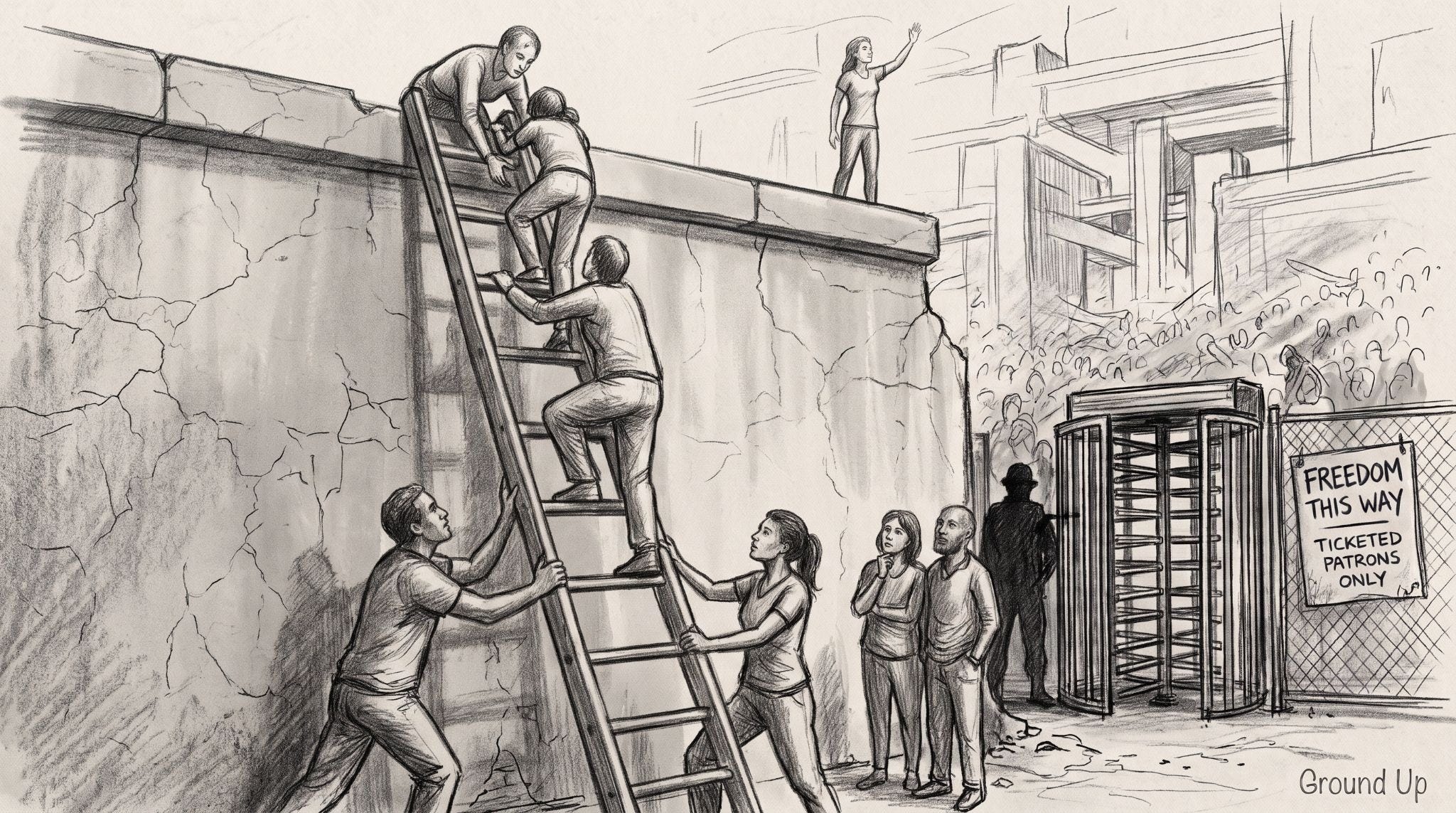
So here’s an effort to sketch that out. Since the terrain will be bumpy and we’ll have to climb, we need a ladder.
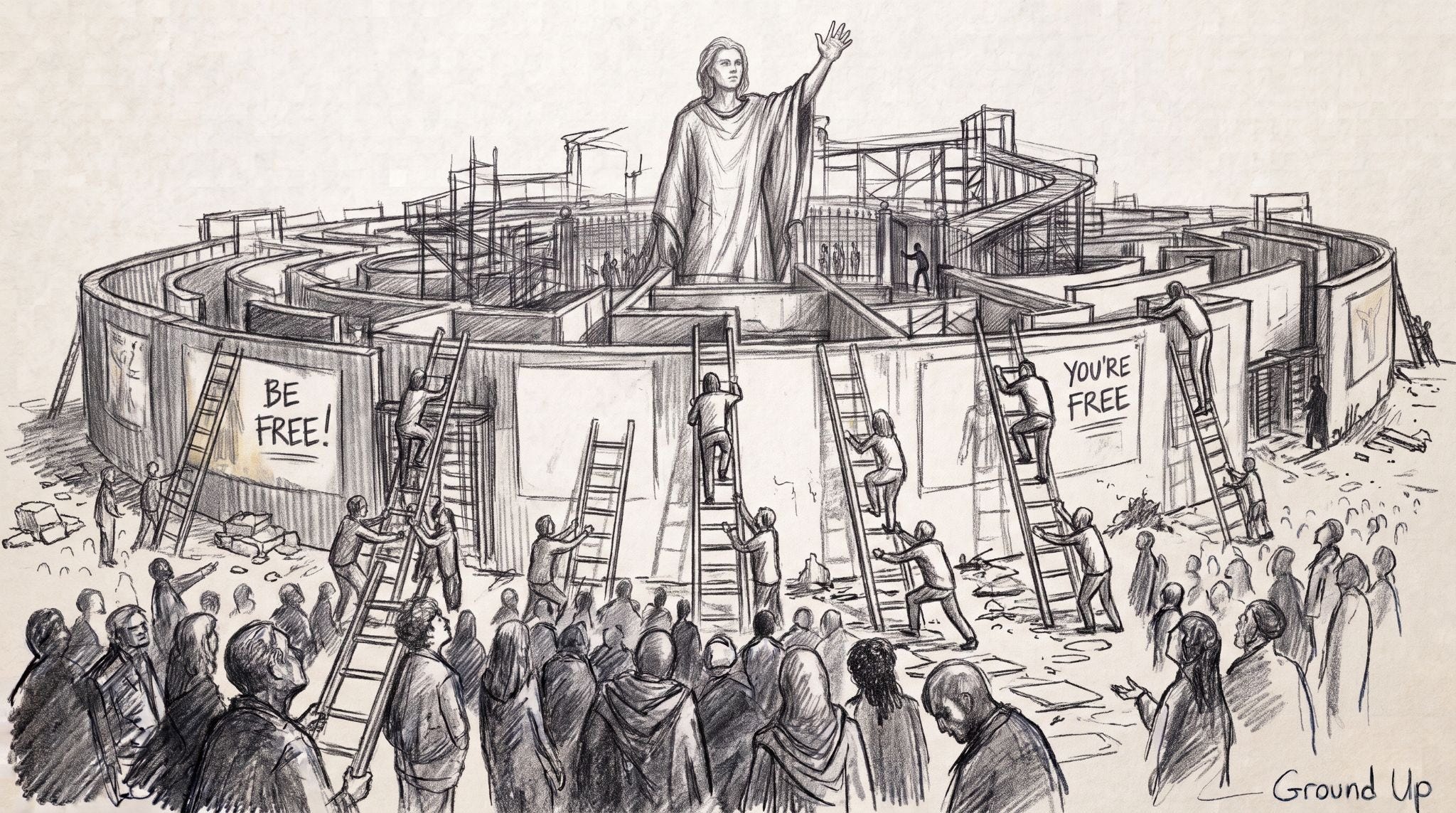
To get to a more inclusive freedom, we need to trust one another. Some will need to brace the ladder for others to climb, some will forge ahead and others will only proceed gingerly. The way becomes more durable if we have faith that every rung is secure and we can help each other move forward.
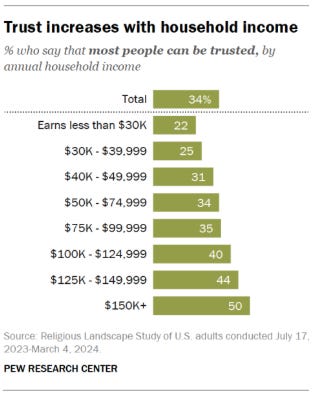
In a world of fragmentation and isolation, trust is complicated and it’s gotten more so. Pew Research found 34% of Americans in 2023–24 said most people can be trusted, down from 46% in 1972, according to the General Social Survey.
Pew also reports that only about one in five households earning under $30,000 have that kind of faith in other people, which underscores the idea that social inclusion comes with a price tag. So it makes sense that the most precarious of us are the most cautious.
Similarly, young people — a group facing difficult economic prospects and a worsening climate crisis — are far more distrustful. According to a poll this year from Marquette Law School, only 35% of people born in the 2000s say most people can be trusted. For those born before 1960, the share is 77%.
Skepticism of others might be a rational defense mechanism, but it makes building connections harder. Overcoming that resistance is part of the ladder’s design. It starts with low-risk, low-threshold interactions to build trust, paving the way for the next step. The stakes rise as we climb one rung after another.
The goal (metaphorically speaking) is to get an unobstructed view of the monument to the free individual and see that it’s mirrored. Once we understand that true freedom is a joint achievement and a common good, the apparatus restricting access will struggle to withstand the pressure and pathways can converge.
To be fair, the ladder metaphor isn’t entirely my idea. It’s borrowed and adapted from Sherry Arnstein, who used it in 1969 to distinguish varying degrees of public participation. She identified eight levels, broken down into three broad categories: non-participation, tokenism and citizen power.
In the U.S. and other Western democracies, we’re in that mid-tier of information, consultation and placation (i.e., tokens of power rather than the real thing).
To really act as free individuals and shape the decisions that affect our lives, we want to be moving up to partnership, delegation and control. We’ll need to work together to get there, and that’s where the ladder of engagement comes in.
Rung 1: Fix something together
The easiest place to start to rebuild trust is common experiences with neighbors, like fussing over something that’s broken. The model for that is the Repair Café.
The community-run facilities are meeting places that offer tools, resources and volunteers to help mend things. The first Repair Café opened in Amsterdam in 2009 and there are now more than 4,000 across more than 40 countries from Australia to Iceland.
What makes it work is the ease of entry. All you need is something broken and the desire to save money and gain a sense of accomplishment by fixing it. Best case, you repair your lamp, bike or sweater. Worst case, it’s still broken, but at least you tried and met some people doing it.
It also shows what can happen when people connect, with the movement helping lead to the European Union’s “right to repair” legislation. Lasting change is where the ladder can lead.
What it costs: an afternoon, and usually nothing else. Other first rungs include things like a tool library, a community garden and a shared neighborhood meal.
Rung 2: Own something together
On the second rung, you share something that matters, like a roof. I wrote about land stewardship projects like the Champlain Housing Trust in Vermont here. A related movement is the Mietshäuser Syndikat in Germany.
After establishing the concept by transforming a former factory in Freiburg into living space in the late 1980s, it’s now grown into a network for 215 projects across the country, helping groups of residents buy buildings and take them off the speculative real estate market. Each house is legally independent and run by its tenants, with the network holding a veto over resale or change to the ownership model.
Fifteen other initiatives are in the works, including a project for nine people in a village near the Baltic Coast. The group is also working on expanding to other European countries. The organizers say that despite the differences between people and projects, they all share “a collective desire for a home where they can live independently.”
Two design choices matter for building trust in something as fundamental as shelter. First, the veto means no future majority of residents can cash out at the expense of the rest. Second, the network helps secure funding by raising money from its members and supporters, a form of collective private financing. So-called direct loans accounted for 39% of the network’s capital base as of March 2025. So growth feeds the pool.
The scale of these projects, though, is tiny and setting each one up takes significant time, effort and resources, but despite the hurdles, the network has kept growing. Worker cooperatives like the Mondragón Corporation (see here) operate on the same principle of shared ownership and rules designed to outlast individual members.
What it costs: real money, legal know-how and a great deal of trust. The network model helps ease the entry by providing structure and expertise.
Rung 3: Decide together
The first two rungs were focused on how individual needs can be met with the help of the community. The third rung turns an individual into an agent for the community.
An increasingly important tool here is the citizens’ assembly. A group — chosen by lottery and balanced to reflect age, gender and income of the community — deliberates with expert input and makes recommendations.
In Ireland, a citizens’ assembly helped break a deadlock on abortion about a decade ago, and Germany has experimented with such assemblies since the 1970s. Some deal with big questions like the country’s role in the world. Others are more focused — such as in Amberg, where a group helped resolve a dispute over the redevelopment of a former nursing home.
Selection is important because open invitations skew toward people who already have a position and are therefore less neutral. Alongside a civic lottery, the OECD recommends compensating participants for time and expenses like childcare. That means tapping resources, which aren’t always available.
Influence depends on political backing. France’s Citizens’ Convention for Climate, for instance, had most recommendations diluted after convening in 2019 and 2020, but even that is still better than others. And many are reduced to tokenism.
What it costs: several weekends. In Amberg, for instance, the assembly met five times to deliberate over a disputed development plan. That’s why compensation can help and assembly representative rather than self-selected.
Rung 4: Work together
The top rung turns local practice and community networks into broader social and political change. Connecting one initiative with another to create a broader ecosystem develops critical mass. While complex, it has happened before.
In The Upswing, Robert Putnam and Shaylyn Romney Garrett show how the U.S. went from an individualistic “I” society in the Gilded Age in the late 1800s to a community-driven “We” culture through the mid-20th century.
The pivot was driven by moral and cultural shifts at the grassroots, like settlement houses that connected rich and poor, a surge in union organizing and the establishment of Boy Scouts of America to teach community values. Change from the ground up is what paved the way for shifts at the top.
“Political leadership was a lagging variable, not a leading one,” Putnam said in an interview with the LA Review of Books. “You might think that in order to get a big change in this society, you’ve got to have a powerful national leader. But that was not true of the Progressive Era, which has direct implications for today.”
We can see similar patterns appearing now. From community gardens and Repair Cafés to housing trusts and citizen forums (even in the U.S.), the people are acting and connecting.
The key task in this rung is to link up. That means joining a national or international federation as well as a local group, backing laws that make lower rungs easier to implement and keeping the doors open to people who aren’t ready to climb yet.
None of these rungs ask you to trust everyone. They build reliance through structure and ask you to be part of strengthening it. The next question is how to tell a good rung from a bad one.
Testing the Rungs
Not every effort to establish a rung is going to be secure. Some groups might be little more than tokenism, and others might be too tightly controlled. These four questions help determine their durability.
Who actually decides? Even well-meaning efforts can concentrate power. Sherry Arnstein defined participation as redistributing power to include those who have been excluded. Elinor Ostrom’s work on managing shared resources (which I also wrote about here) similarly calls for arrangements that let the people affected help make the rules.
In practice, that means members who vote on budgets and bylaws, decisions that are written down and enforceable, and a process to remove leaders.
Who’s missing and what are the barriers to entry? Participation in any group isn’t free and usually costs time, at least. Some can afford the price of entry more than others, so compensation helps open the door wider. Convenient meeting times or remote participation can be a low-cost alternative.
Also, new groups tend to be fairly homogenous (friends, families and colleagues), so there should be a process and an intent to actively reach out and welcome people who aren’t like the other members.
What stops it from being captured? Big donors or well-organized can dominate a group. The Mietshäuser Syndikat’s veto is one example of how to erect a safety net for minority interests.
Transparent financing, term limits and a clear process for resolving disputes show that a group is built for community rather than individual interests. Ostrom’s design principles add monitoring and graduated sanctions to prevent abuse.
Does it connect outward? Groups that want to build something rather than control something will be part of something bigger, like a network or a federation.
Shared know-how and ties to like-minded groups help secure the ladder, while isolation and treating peers as rivals create instability. In Ostrom’s terms, durable governance is nested, with small groups linked into larger ones.
No group will be perfect, and the test is to help decide where to push for improvement, rather than whether to join. As Putnam and Garrett show, participation from the ground up is itself part of the solution.